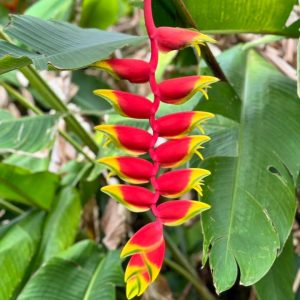
The humble heliconia is a staple in the tropical-style garden – and thankfully, there are many varieties that will grow well below the tropic of Capricorn, even down to coastal Sydney and Melbourne in protected microclimates.
I have been growing them for a couple of years now in Brisbane, and they have become by far my favourite ornamental plants.
While the climate here might seem agreeable, Brisbane weather can still be quite savage for tropical plants – and some of the more tropical heliconias will not grow here with much success. But there are several varieties that grow wonderfully; here is a selection of what I think are 5 of the best for subtropical and temperate growers.
‘Tropics’ – H. psittacorum x spathocircinata
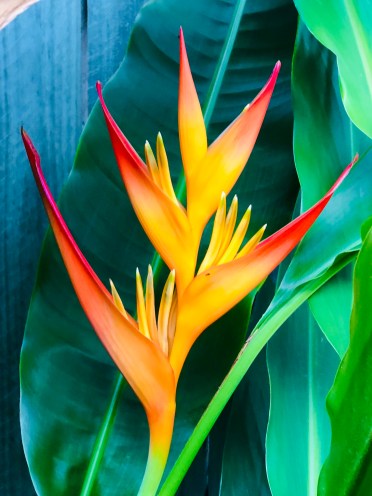
Perfect for: growing in large containers, landscaping, smaller cut flowers, wind resistance, cold resistance (down to 5 degrees celsius).
This is one of the few psittacorum type heliconias I think is worth growing in smaller gardens in the subtropics. A lot of the other psittacorums look really shabby in winter, whereas this one strides through winter while maintaining a compact, lush, tight clumping appearance, but still vigorous enough to fill a space in the garden quickly. It doesn’t have the same ‘running’ characteristics of other psittacorum heliconias which I have frequently found sneaking under garden edging and popping up in lawns.
‘Tropics’ also holds up to wind well, and is one of the heliconias more likely to grow down in coastal Sydney as it is quite cold tolerant. A very vigorous but ‘well behaved’ heliconia which makes an excellent plant for landscaping.
With a name like ‘Tropics’, who could argue that this plant was not made for tropical gardens!
‘Hot Rio Nites’ – H. caribaea x bihai

Perfect for: landscaping, wind resistance, cold resistance, larger cut flowers, mid-sized canopy for sun-sensitive plants.
Hot Rio Nites is one of the single most popular landscaping heliconias in South East Queensland, and for good reason. It is relatively hardy, tight clumping, non-invasive, has spectacular flowers and foliage, and holds up to our drier weather and cooler temperatures in the mid to late parts of the year.
This really is a performer in the garden, and can be grown in coastal Sydney with some protection. It can grow quite tall if grown in shade (I have seen some specimens in the Mount Coot-tha Botanic Gardens topping about 5 meters), but grown in full sun it will generally max out at 4 meters.
I have also found this heliconia to be more tolerant of wind than some of the other species, although leaves may get shredded. The flower bracts may appear either erect or semi-pendulous.
Hot Rio Nites is another really evocative name that I love that makes this plant even more exotic and interesting.
Heliconia rostrata
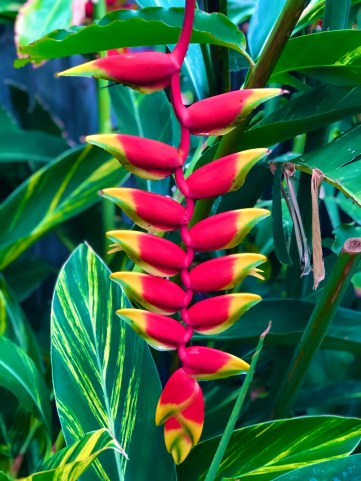
Perfect for: interesting pendulous flowers used for a stunning effect in landscapes, cold tolerance, interplanting close to other heliconias.
Heliconia rostrata is probably the most widely cultivated heliconia around the world and should be fairly easy to come by in warmer regions.
There is really only one reason you grow this plant, and that is for the stunning pendulous flower bracts – they really are spectacular.
The foliage isn’t much to look at though, easily shredded by wind and usually looks scrappy. It will look its best when given partial shade and some shelter from strong winds.
For that reason, I grow H. rostrata close to other heliconias (they don’t mind growing up through other plants), as this hides the foliage in amongst other plants and helps protect it but you still get to enjoy these stunning bracts.
It is quite cold tolerant (down to 5 degrees celsius) and will grow in coastal Sydney in a sheltered spot.
‘Fan’ – H. lingulata
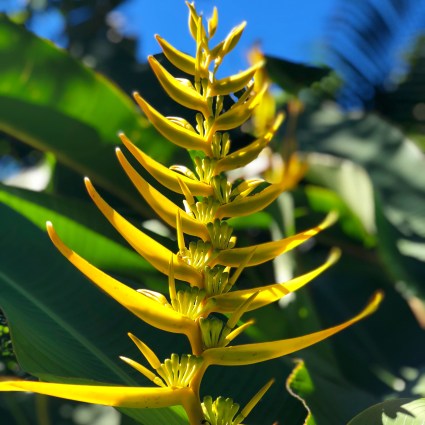
Perfect for: reliable flowering, resistance to elements, OK as a cut flower
This is a tough heliconia. It’s also one of the most reliable flowering heliconias in my garden – I practically get flower bracts year-round.
The leaves seem to be thicker than other heliconia varieties which makes it more resistant to wind, dry weather, or colder conditions. It easily handles temperatures down to 5 degrees celsius. It would be one of the better heliconias to try if you have sub-optimal conditions.
The flower bracts are also interesting to look at, and there is a red-tipped form available.
‘Red Christmas’ – H. angusta
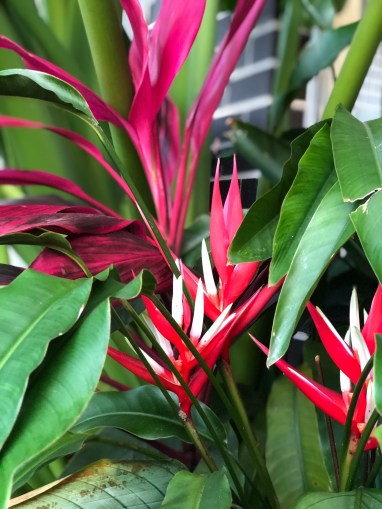
Perfect for: shady spots, winter flowering, cold tolerance, growing in pots, growing in shade
I have found ‘Red Christmas’ to be a reliable heliconia in South East Queensland, and is one of the better heliconias to grow if you live in a particularly mountainous forested area within the subtropics as it will take cooler conditions than almost all the other heliconias.
This is the only heliconia on this list that I would suggest someone in Melbourne might be able to grow in a protected microclimate. It should not have any problem growing in Sydney with adequate water and plenty of shade. It is native to Southern Brazil, where the climate is analogous to South East Queensland. It performs wonderfully in Brisbane. It probably won’t perform all that well in the tropics, unless you live at higher elevations.
Unlike most of the other heliconias, this heliconia is winter flowering so will give you colour whilst the other heliconias are dormant. It is low growing (up to 1 meter) in smaller clumps, and therefore will not take up much space.
*****
The above 5 varieties are a good place to start if you are looking to start growing heliconias in the subtropics, or just need some landscaping ideas, but there are many other varieties which will perform just as well.

 Zacaconia Tropical Gardens
Some sellers on ebay with misinformation stating species like rostrata are not tolerant of any cold full stop……geeez
Hello, thank you for this wonderful information on heliconias. I was wondering if you could help me. I have 10 metres = 5 x 2 metres long of corten steel garden beds. They are 600mm high from ground level and only about 600 wide as well. They sit behind my pool up against a fence that is not high enough to screen my neighbours. I was really wanting a tall screening plant that would grow higher than the 1800 fence they will be up against, so would need to grow to a minimum 1200 high, ideally 1500 or so. They would also need to tolerate full morning summer sun and screen out the afternoon sun which will be behind them. Hoping to put a lovely trailing plant in front of them to hang over the edge of the corten steel garden beds and create a lovely back drop for the pool. Do you think heliconias would be suitable, and if so, which of your favourites would you recommend would thrive in the largely full sun? I really want them to be beautiful as they will be a feature.
I hope that all makes sense. 🙂
I would be very grateful for your advice. Have a lovely weekend.
Kind regards
Karen
Hi Karen,
Thank you for your comment! I’m glad you found the information I posted about heliconias helpful 🙂
In such a narrow space next to a pool, I would suggest Heliconia ‘Tropics’ AKA ‘Tropifleur’ will give you the best look. It will also achieve the screening effect you’re looking for. As an added benefit, it does not run and has a nice tidy tight clumping habit. It is very vigorous growing, and will grow well in full sun. Perhaps you could look at a trailing plant like Dichondra ‘Silver Falls’ in front of them which have a lovely cascading growth habit and silvery foliage which will contrast beautifully with the ‘Tropics’ planted next to your pool. ‘Silver Falls’ also looks nice with corten steel.
Hope this information is helpful – I would love to see pictures of what you choose to do (or have already done – I realise my reply has come very late!)
Have a great New Year and wishing you a prosperous 2025 🙂
Kind regards,
Zac
I have come across this frequently with tropical plants… some sellers on eBay are in the tropics and don’t have much experience growing plants in cooler climates, assuming they are exclusively tropical. Red Christmas, for example, actually prefers subtropical conditions because of its native habitat in Southern Brazil.