When I was conducting house history research of our 1914 Queenslander in Brisabane a few years ago, I found some newspaper clippings about the original owners’ love of plants and their large ‘bush house’ or fernery. Mr and Mrs Burns, as it turns out, were avid horticulturalists and grew a variety of plants in this shadehouse which once occupied the part of our block where our gate and driveway now is.
A 1919 newspaper ad for an auction of the house and its chattels reads:
…[A] CHOICE SELECTION OF POT PLANTS AND BASKETS OF FERNS, &c., of LARGE VARIETY, of about 1,000 In pots to suit purchasers, including nine tables of FERNS, DAVALIAS, JAPONICA, POLYPODRUM, NIGRESCERO, FEGIENSI, IROIDES, CRESTATA, DECUMBEN, DRACAENA…
What caught my attention was the inclusion of dracaenas. When we purchased the house, it came with some existing plantings but almost no dracaenas – except for one D. warneckii. I will never know if this was one of the original plantings, but I would imagine highly unlikely given the long passage of time in between then and now. Another thing worth noting is that cordylines were once classified as ‘dracaenas’, so it may be impossible to know what specific plants were growing here at the time.
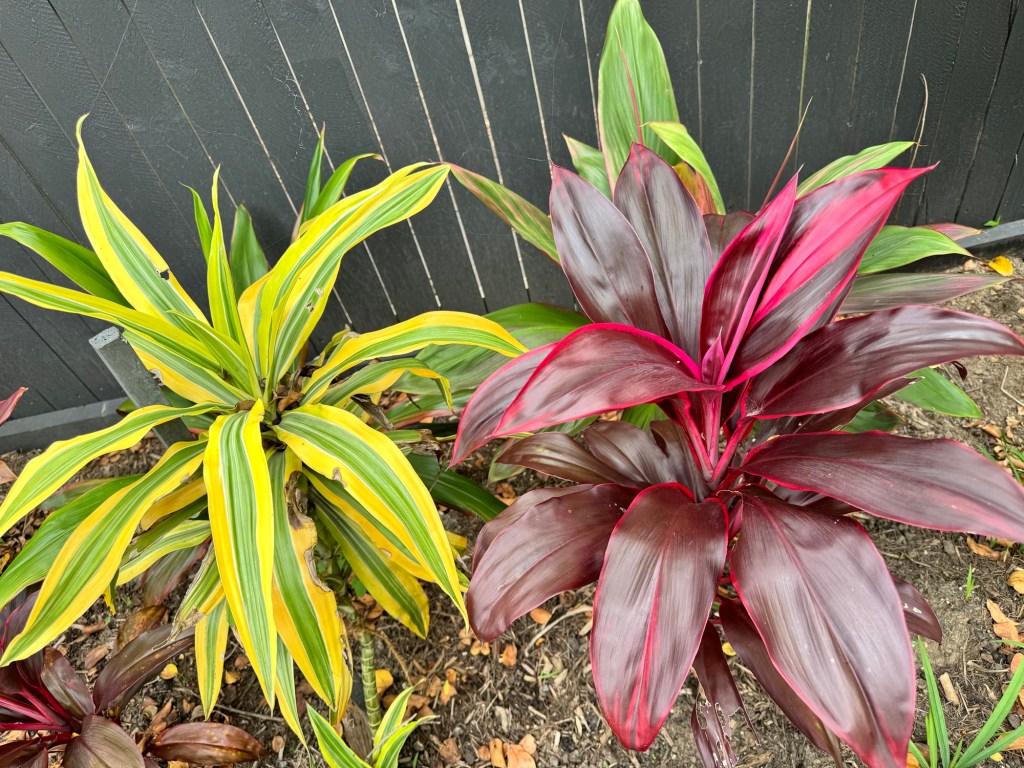
I had since attended one of Denis Hundscheidt’s garden workshops in 2023, and one thing I noticed was his extensive use of dracaenas throughout his garden. We have had a few dracenas growing, such as the original D. warneckii, D. reflexa or ‘Song of India’ and ‘Song of Jamaica’ (now classified into their own genus Pleomele). But this workshop made me realise I had untapped this wonderful resource of very hardy, tropical-looking plants that are ideal for Brisbane’s climate, have few issues with pests and diseases and will often survive on just rainfall alone. They also complement the cordylines and other tropical plants in our garden, providing contrast of foliage shape and colour.
So I set out to start collecting a few key varieties of dracaenas – some of my favourites so far are ‘Lemon Lime’, ‘Compacta’, ‘Limelight’ (a lime green version of ‘Janet Craig’), and ‘Florida Beauty’ along with a fine leafed form of ‘Song of India’ Pleomele reflexa ‘angusta’.
‘Lemon Lime’ provides highlights throughout our garden, and as they grow I intend to take more cuttings and contrast with reds and purples of cordylines, graptophulums, and crotons.

Some varieties I am looking for still are ‘Malaika’ and ‘Lemon Surprise’ (a curly leafed version of ‘Lemon Surprise’). While these varieties appear to be available in abundance in North America as houseplants, there is an absolute paucity of them here in Australia.
I will just have to keep my eyes peeled!


 Zacaconia Tropical Gardens