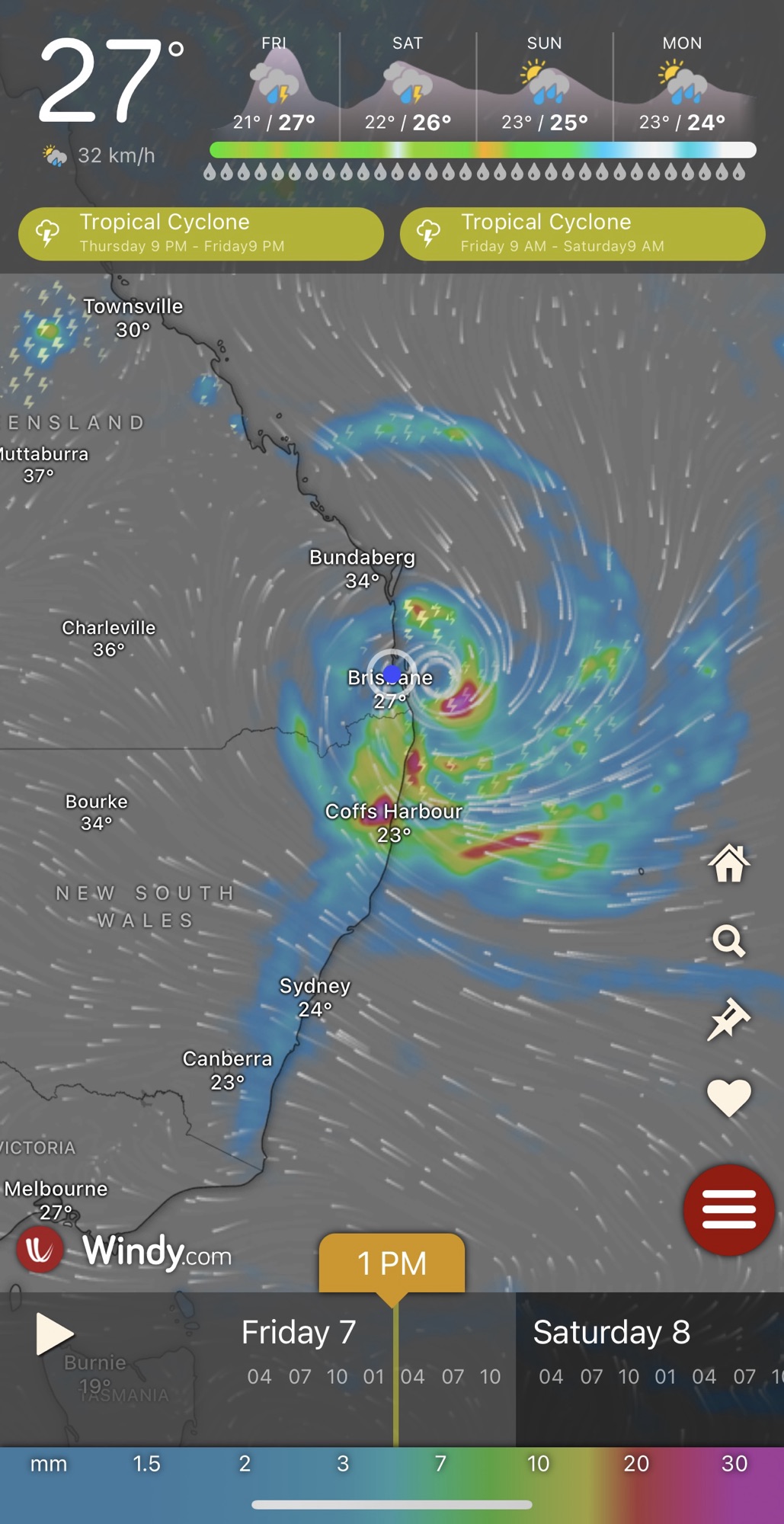
A tropical cyclone heading for 4 million people in a subtropical region that doesn’t normally get cyclones? What could go wrong! For the first time in 50 years, Brisbane has seen it’s first cyclone (dubbed rather endearingly, ‘Alfred’). Or at least a slightly less toothy version of one.
South East Queensland is known for wicked storms, but rarely do we see cyclones. That said, Tropical Cyclones have reached Brisbane in the past. The last one was in 1974. There have been several near misses since then, the most recent in 2019.
What we did to prepare
After reading some posts in some Facebook gardening groups written by gardeners in Far North Queensland (who regularly experience cyclones), we took some preemptive measures:
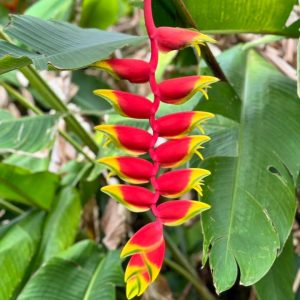
- Pruned excess growth from large plants, heliconias, and the lower leaves from exposed palms.
- Put away outdoor furniture under our house, which is a Queenslander
- Took down any hanging baskets and wind chimes and placed these on the ground.
- Moved potted plants (thankfully most of these were small pots) into more sheltered areas of the garden.
- Emptied our water tanks by watering the garden for several hours a few days before expected landfall (given we have 15,000L of water storage, and were expecting this to fill up)
7th of March 2025 – Friday night
As Alfred crossed over Moreton Island, he entered Moreton Bay. We were lashed with the edge of the cyclone from about 11pm to midnight. It was a Category 1 system at this stage. The eye of the cyclone never fully made a crossing onto land. Instead, it stayed over Moreton Bay. Then, it took an unexpected turn north toward Bribie Island. We were largely spared from the full force of the wind here in Brisbane’s inner-north. The wind was gale force, but not strong enough to cause any significant damage in our local area. Our house and garden survived with no real damage to note.
8th of March 2025 – Saturday night
The weather throughout Saturday was quite favorable for the inner north of Brisbane. Alfred was downgraded to ‘Ex-Tropical Cyclone’ status. There was patchy rain throughout the day and periods of sunny weather. There was little in the way of wind. This gave people in Brisbane a false sense of security. By the evening, the weather took a turn for the worse. The winds and rain were actually stronger than the night before. Our garden still did not sustain any significant damage. However, our water tanks quickly filled up and began overflowing. Our pool also began to overflow. There were reports from Redcliffe, however, of roofs being lifted from houses. Unprotected coastal areas experienced winds up to 145km/h. The highest winds we experienced on Saturday were in the 90s, due to being a little bit more inland.
9th of March – Sunday night
Much of the rain continued throughout Saturday, and the conditions were reminiscent of the 2022 Brisbane floods. Naturally, many areas of Brisbane flooded after receiving extremely high levels of rainfall. We did not sustain any flooding in our area. This area is not known to flood. However, there are low lying areas nearby that regularly flood.
Aftermath
With little damage to our property and garden, cleanup has been minimal. We have been cleaning up leaves and small branches and that has been about it. Since venturing out, I’ve noticed some trees have been blown over. Some areas still remained flooded around Brisbane early in the week.
I am sure some of the preparation we did was worthwhile. It helped us avoid casualties in the garden. It also prevented potential property damage. I have seen snapped palms around our suburb, however all of our palms survived without any notable damage.
Another thing that has become clear is the role of the islands around Brisbane and the Gold Coast. They provided a ‘buffer’ against the full force of Alfred. The storm weakened as it entered Moreton Bay.
It’s now well into the following week, and life has largely resumed back to normal. Many areas in SEQ have been without power, and some areas flooded. Cyclone Alfred had the potential to be so much worse. But for the most part we have survived unscathed. That was the best outcome we could have hoped for. Cyclone Alfred has highlighted how unprepared we all are for these types of weather events. It should function as a warning to ‘cyclone proof’ our SEQ cities!
 Zacaconia Tropical Gardens