Earlier this year, Gardening Australia ran a segment on how to propagate cardamom from store bought pods.
True cardamom (Elettaria cardamomum) is very difficult to find in nurseries in Australia, with most nurseries selling the false variety, AKA Cardamom Ginger or Dwarf Cardamom (Alpinia nutans or Alpinia mutica). The false varieties have cardamom-scented leaves and are a useful landscaping plants, but will not produce the pods you can use in cooking.
I have now made three attempts at growing cardamom from store bought pods, and have had no success so far. True cardamom is notoriously difficult to propagate from seed, and the germination rate is very low. I have read that you will have much more success with freshly produced pods that have been allowed to fully ripen on the plant. The pods you buy from the store have been picked before becoming fully ripe as this is the optimal time to harvest the pods for the spice, but not for germination. They have also been dried, and most seeds you buy this way will not be viable.
I intend to keep trying to propagate the pods. I have bought organic cardamom pods as they have not been chemically treated or irradiated, which would further reduce the germination rate.
EDIT 28/12/2018: I can confirm my cardamom pods/seeds have finally germinated and I have at least four plants out of over 100 pods (the germination rate is indeed low). My suspicion was correct – you need to buy certified organic pods for it to work, and be prepared to wait a month or two. Whatever treatment process is used in the non-organic pods (I suspect irradiation is the main method) makes the seed no longer viable. Depending on what certification standard is used, the certified organic pods should not be irradiated. Sowing should be done during the warmer months and be prepared to be patient! Mine took nearly 2 months to germinate. Photos to follow in a later post.
As cardamom seed embryos are encased in a hard black outer shell, some websites suggest scarifying the seeds in nitric acid or hydrochloric acid to assist in germination. I don’t have access to either or these chemicals, nor do I want to work with hazardous substances, so my attempts have been confined to cutting the pods in half and soaking in water overnight.
If you don’t want to wait to grow cardamom from seed, there are at least three suppliers in South East Queensland and Northern New South Wales that I am fairly confident sell the real deal: Daley’s Fruit Tree Nursery, All Rare Herbs, and Green Harvest – I bought mine from Daley’s Fruit Tree Nursery, which is primarily an online nursery based just outside of Kyogle NSW. They have a very good reputation and stock a lot of hard-to-find plants, and all of my experience of buying plants from them has been good.
I had to sign up to be notified by email when the cardamom became available, because it is not something that there is a huge supply of anywhere in Australia. As soon as I got the email, I bought the cardamom online and it arrived a few days later.
There is a review from a customer on the Daley’s cardamom page that confirms they stock the real cardamom and that the plant they purchased from them has flowered – as soon as you see the flowers of the plant, you will know what plant you have as the flowers of True and False Cardamom are quite different (True Cardamom has flowers . Apparently, Daley’s propagate their cardamom from seed, which is also reassuring. They also sell the false variety of cardamom on their website.
When I received the plant, the leaves did not have the fragrant cardamom aroma of the false cardamom I have previously seen growing (apparently cardamom leaves do not have as much of an aroma. They are also not glossy like Alpinia nutans or A. mutica. The undersides of the leaves have fine hairs on them, which is a further clue that I have the Malabar variety of cardamom (the Alpina false cardamoms do not have fine hairs on their leaves).
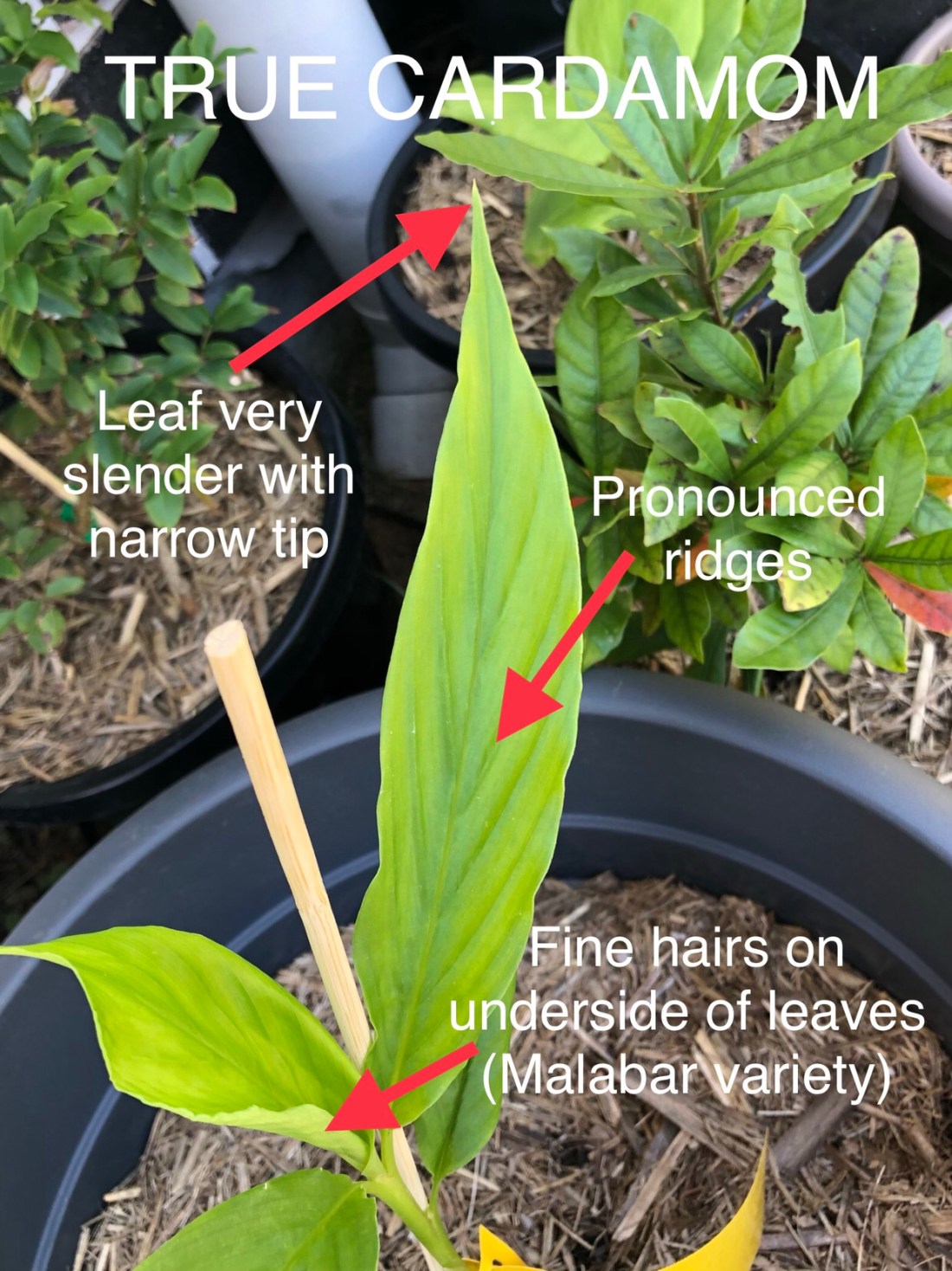
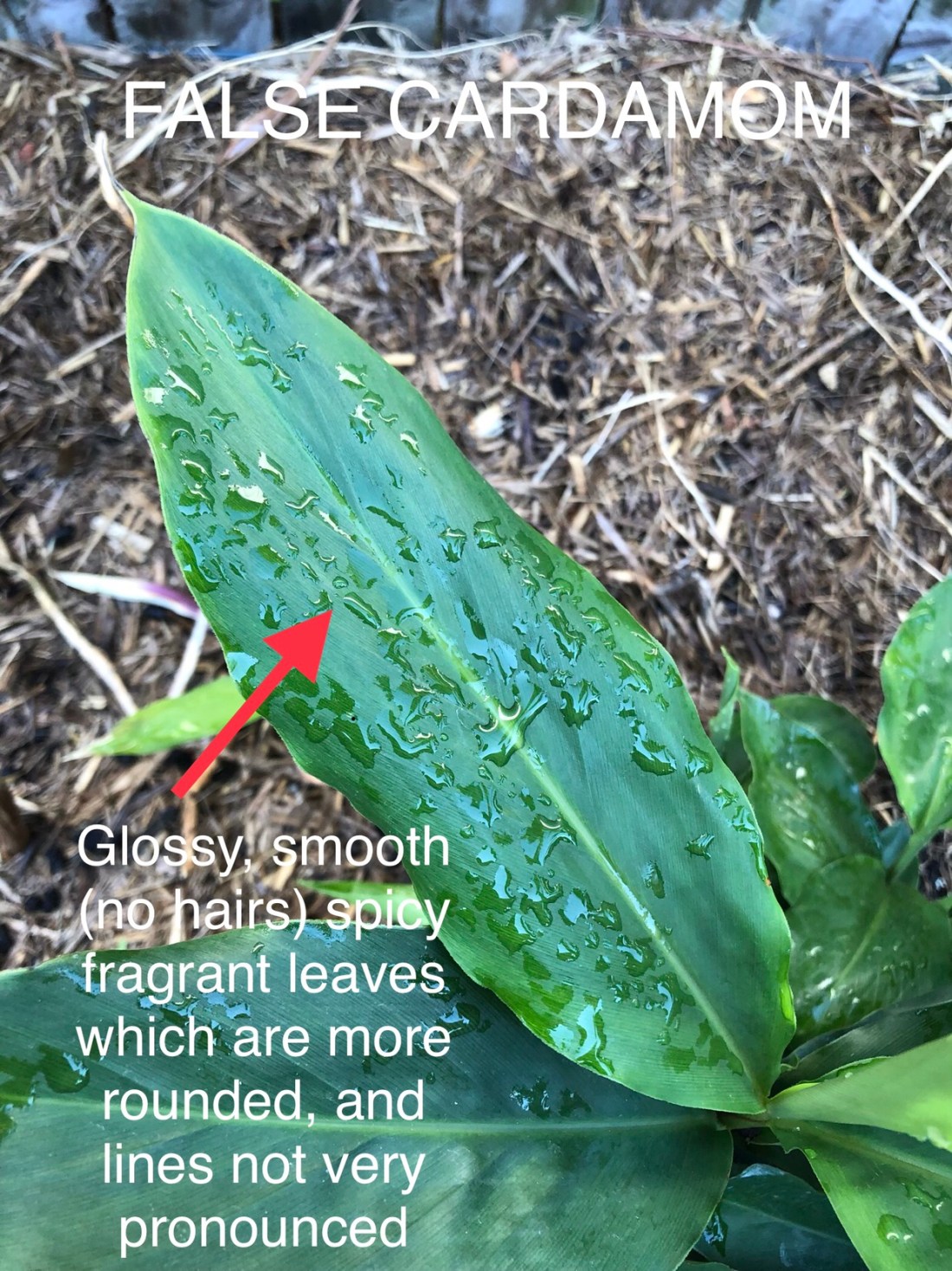
True cardamom leaves are very slender and have a very distinct dagger-like point on their leaves. The leaves have very pronounced ridges radiating from the midrib to the edge of the leaves. False cardamom leaves are more rounded and the ridges are not very pronounced.
I have heard from a volunteer of the Northey Street City Farm in Brisbane that Green Harvest in Maleny also sells the real deal (apparently they are a supplier of the Northey Street City Farm Nursery) – however I have not personally seen their plants like I have the ones grown at Daley’s and All Rare Herbs, which I can confirm are the Malabar variety of Cardamom. Green Harvest grows their True Cardamom from seed and I have heard they are also a reputable supplier of hard to find plants, although I have not bought any plants from them myself.
If you are not convinced you have real cardamom, you will know for certain in several years time when it eventually flowers. True Cardamom flowers grow on horizontal stems from the base of the plant, and they are blue and white. False Cardamom flowers are yellow/orange and white, and very similar to the flowers of Shell Ginger (Alpinia zerumbet).
With some careful observation, it is possible to distinguish between the True and False cardamom before they flower. While both are members of the Zingiberaceae or the ginger family, they are quite different. If you are growing cardamom purely for the appearance of the leaves, you should grow Alpinia nutans as it is an excellent landscaping plant which is drought and cold tolerant. The leaves are also good as a flavour infusion in food and teas. True cardamom is a little more picky and requires more care and water, but growing your own cardamom spice could be well worth the effort.
*****
On a completely unrelated note, this would have to be the first blog post I have ever published at 10,000 feet above ground – ah, the wonders of inflight wifi! I will enjoy the novelty for now – maybe someone reading in a few years time will laugh at how backward and troglodytic we were in 2018!

 Zacaconia Tropical Gardens